
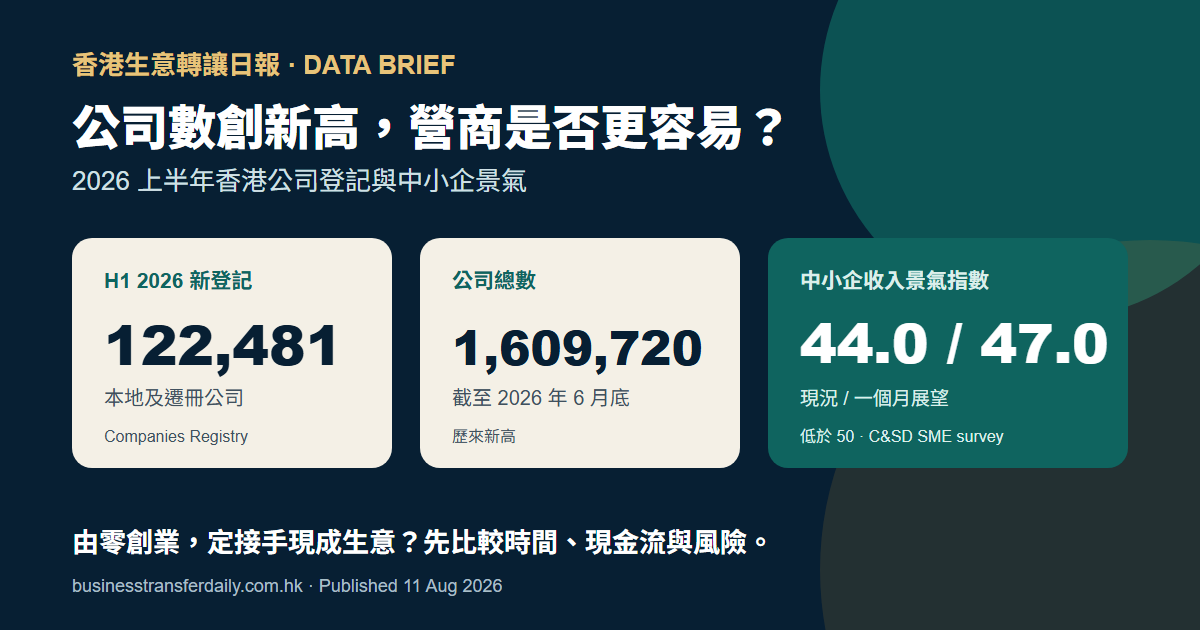
Hong Kong's Companies Registry reported 122,481 newly registered local and re-domiciled companies in the first half of 2026. The total number of local companies reached an all-time high of 1,609,720 at the end of June. Yet the Government's SME survey put the June current and one-month-ahead diffusion indices (DIs) for business receipts at 44.0 and 47.0, both below 50.
Facts published by the Government
- 122,481 newly registered local and re-domiciled companies in H1 2026.
- 1,609,720 local companies at end-June 2026, an all-time high.
- June 2026 SME business-receipts DI: 44.0 current and 47.0 one-month-ahead.
- The monthly survey covers companies with fewer than 50 persons engaged and a panel sample of about 600 SMEs. A reading above 50 is generally favourable; below 50 indicates otherwise.
Important: a DI is a survey indicator. A reading of 44.0 does not mean actual receipts fell by 6%, and it is not a hard measure of territory-wide SME turnover.
Why more companies do not automatically mean easier operating conditions
BTD editorial analysisRegistration statistics measure the creation and re-domiciliation of legal entities. The SME survey measures respondents' views of their own short-term business-receipts conditions. New ventures, investment structures and re-domiciliation can lift the first measure while existing firms remain cautious about demand, costs and uncertainty. The two results can coexist.
For a prospective owner, the practical question is therefore not simply how many companies exist. It is whether to build a venture from zero or acquire one of the businesses already offered for sale.
Starting from scratch versus buying an existing business
| Factor | Start from scratch | Buy an existing business |
|---|---|---|
| Upfront cost | You can start small, but premises, fit-out, equipment, deposits, launch marketing and experimentation are separate costs. | A transfer price is normally due, plus stock, deposits and working capital. The exact asset scope must be documented. |
| Time to trade | Site selection, fit-out, hiring, licences and customer acquisition can extend the pre-opening period. | Operations may begin faster if the lease, licences, staff and systems transfer successfully. |
| Cash flow | There is no trading history and the runway may need to cover a longer ramp-up. | Revenue may continue, but seller figures must be reconciled with POS, bank and invoice records. |
| Lease and licences | Applications start afresh, with approval and fit-out risk. | Never assume they transfer automatically; obtain landlord and regulator confirmation. |
| Customers and brand | Greater freedom, but trust and demand start at zero. | Customers, reviews and channels may come with the operation, but verify whether they depend on the company, location, owner or platform account. |
Use our Hong Kong buyer guide, guide to reading a business listing and valuation framework to compare total capital at risk rather than the asking price alone.
Five due-diligence checks before taking over
- Financial and tax records: reconcile POS reports, bank deposits, platform settlements, supplier invoices, payroll and tax filings; separate recurring from one-off items.
- Lease and premises: check term, rent reviews, renewal rights, permitted use, deposits, assignment restrictions and written landlord consent.
- Licences and compliance: confirm holder, address, validity, conditions, re-application timetable and completion conditions. See our lease and licensing guide.
- Assets, liabilities and stock: document title, hire purchase, maintenance, stock valuation, unpaid bills, refunds and warranty obligations.
- Customers, suppliers, staff and digital assets: assess concentration and key-person risk, employment liabilities, and whether domains, phone numbers, POS, delivery platforms and social accounts can transfer legally.
Work through the full BTD due-diligence checklist. Transaction documents should be reviewed for the specific facts by qualified legal, accounting and licensing advisers.
Frequently asked questions
Does a record number of companies mean starting a business is easier?
Not necessarily. Registration counts do not show whether every company is active or profitable, and the SME survey still reflected cautious sentiment.
Is buying an existing business always faster?
It can be, but an unresolved lease, licence, asset, staffing or account transfer can delay opening.
What are the minimum checks before buying?
Verify financial and bank records, the lease, licences, assets and liabilities, and the transferability of customers, suppliers, staff and digital accounts.
Does DI 44.0 mean receipts fell by 6%?
No. It is a survey indicator, not a percentage change in actual receipts.
Sources
- Companies Registry, H1 2026 company-registration statistics press release, 17 July 2026.
- Census and Statistics Department, Monthly Survey on the Business Situation of SMEs for June 2026, 10 July 2026.
Government-published facts and BTD editorial analysis are labelled separately. This article is general educational and market information, not investment, legal, valuation, tax or financial advice. Public listing and seller-supplied figures are unverified; conduct independent due diligence and obtain professional advice before committing.